
- 20 نيسان 2013
- أقلام مقدسية
There was a land of Cavaliers and Cotton Fields called the Old South. Here in this pretty world, Gallantry took its last bow. Here was the last ever to be seen of Knights and their Ladies Fair, of Master and of Slave. Look for it only in books, for it is no more than a dream remembered, a Civilization gone with the wind...
—Introductory foreword to the film, Gone with the Wind
“He’ll beat you up. I won’t look!’ My daughter warned me as I parked the car and prepared to get out and tell off the driver who had inconsiderately blocked traffic.
To drive into Al-Sahel neighbourhood in Sho’fat, the residents take an illegal shortcut that first requires a right turn followed immediately by a U-turn at the traffic light. Since other cars wait until the light changes before they can move, the drivers who want to make the illegal turn must wait for these cars to move. As they wait for their chance to turn, they block the road for the cars behind them.
The obnoxious driver who impudently blocked the traffic circulation at the illegal turn finally moved, crossed the street, and parked in front of the grocery across the road. I decided to give him a piece of my mind. I had already arrived at the driver’s window when, to my embarrassment, I recognised him as my mother’s gynaecologist and one of my readers, who had delivered me half a century ago.
“I told him not to take the turn,” his octogenarian wife apologised. His wrinkled face was flustered and red.
“I have come to say hello. It is a long time since I last saw you.” Their winter house is one block up the street from my house in Jericho.
“I always go to the end of the road and take the turn from over there,” she chastised her husband.
“If people like us behave this way, what do we leave for the others? ( اذا اللي زينا عملنا هيك شو تركنا للتانين ).” I could not keep my polite, deferential poise.
Civil public behaviour and proper social conduct has sustained a great blow in contemporary Palestinian culture on both sides of the Jordan River. Robin Hood-style bravado within the overall context of the massive brain drain and the passing of the older generation of cosmopolitan, urban, British Mandate Palestinian gentlemen and ladies has undermined public conduct. A new impetuous, narcissistic, crude, pushy, diffident aggressiveness dominates the use of public space, especially the motorway. The image of the Ottoman effendi with defined good manners, a highly elaborate, ritualised code of honesty, integrity, and highly polished cosmopolitan mannerisms, aesthetic refinement, and worldliness typical of Palestinian urban centres has become a nostalgic memory.
Human social behaviour is multifaceted and the cultural ethos is expressed by key symbols, which represent cultural traits. The symbolically evocative concepts of bravado (shatarah الشطاره) and impetuousness (nazaqah نزاقه) – a modern reformulation of the ancient Semitic characteristic of nomadic raiding and looting ( الغزو والغنيمة والسلب والنهب) – underlie the heedlessness civil public conduct and point to an interpretation that contextualises this social phenomenon in the absence of a powerful centralised legitimate state.
Palestinian bravado, swashbuckling, and impetuousness, expressed in the words shatarah and nazaqah, work in conjunction with one another to create the contemporary cultural patterns underlying social interactions. It is the nature of these patterns to be not just extrinsic sources of information, but also shapers of that information. This dual aspect of cultural patterns may be understood as providing models of and models for behaviour which produce aspects of the Palestinian worldview and ethos. In other words, the sense of the everyday is coloured by the sense of an ideal, which, in turn, is shaped by the everyday. Bravado and impetuousness are key symbolic concepts informing current behaviour, epitomised in the ritualised drama of driving.
While driving, proper public codes of courtesy are constantly ignored, undermined, and shoved aside by the majority. A drive from Jerusalem to Haifa is less emotionally aggravating than a drive through Sho’fat to Ja’far’s supermarket in Beit Hanina. The problematic, aggressive behaviour on the roads, such as cutting unexpectedly into another lane, straddling two lanes, and tailing, is both frustrating and maddening. Double parking is a minor problem next to finding one’s parked car blocked by a double-parked car and the totally egoistic driver nowhere in sight. In order to avoid this frustration, one rarely leaves the house.
The situation in Anata, Isawiyyeh, and Jabal Mukabber is further exacerbated by the crowded conditions and population density. Of course, driving in places such as Ramallah demands so much self-control, and is so extremely trying and emotionally exhausting that one minimises one’s ventures into the West Bank. Similarly, the streets in Amman, a predominantly Palestinian city, are mayhem. The degeneration of public social behaviour cannot be causally attributed to the Intifada, to the Israeli Occupation or to any single simplistic reason. Rather it is a complex worldview of a society in transition from a rural to an urban demographic context.
I was conducting my fieldwork near Ras Karkar west of Ramallah. The road linking Ras Karkar to Kufr Ni’meh barely accommodates two cars across. I was balancing myself carefully on the narrow road when a van appeared overloaded with olive twigs, which overflowed from the sides. I stopped the car and told off the driver.
“You will scratch not only my car but all cars! How dare you fill the car this way! It is against the law!”
“I do not see law in sight” He gawked, “Where is it?” He laughed, saucily proud of his presumed shrewd answer.
“The law should be in your heart. No one ought to brandish a stick against you to know the law!”
A popular folk adage sums up the Palestinian perception of the relation between self and others, “I am against my brother, my brother and I are against my cousin, and my cousin and I are against the outsider.” Hate is an integral aspect of social interaction. Coupled with bravado, or shatarah, and impudent impetuousness, the emerging social spectacle has gone terribly wrong. Palestinian society faces a decisive moral and ethical crisis.
From an ethnographic perspective, driving is a highly structured mode of behaviour. Just as cars are a metaphor for their owners, driving is a metaphor for Palestinian social behaviour. On the road, the rational and the irrational, love and hate, ego and id, and the creative power of aroused masculinity and the destructive power of careless swashbuckling fuse in a drama of jealousy, envy, hatred, machismo, and impudence.
The ritual of driving dramatises ordinary, everyday experience and renders it comprehensible by presenting it in terms of acts and objects which have had their practical consequences removed and been reduced to the level of sheer appearances. Thus, their meanings can be more powerfully articulated and more exactly perceived. As an image, a fiction, a model, and a metaphor, driving is a means of expression. Its function is neither to assuage social passions nor to heighten them, but, in a medium of metal, money, speed, and spectators, to display them.
But driving is more than simply acting out Palestinian values and confirming status and individual prestige. Rather, by symbolically expressing those ideas while driving, they become social values. Like other symbolic actions, driving is not merely a reflection of a pre-existing sensibility analogically represented; rather it is a dramatic agent in the creation and maintenance of such a sensibility. Through driving, Palestinians simultaneously form their own temperaments and the temperament of society, or at least facets of each. In this way, the inner becomes outer, i.e. is externalised, and the subjective world picture becomes a social reality. It is a vicious circle that draws everyone into it.
Shatarah or bravado, once a negative behaviour, is now positively condoned. Al-shater is one who does not allow other cars to pass. Al-shater is the one one who cuts you off. Al-shater is the one who gets ahead irrespective of the means. “Be shater,” the mother advises her son or daughter as she packs their sandwiches. “Don’t be a fool (ahbal) and let the others eat your food.” Children are advised not to help their classmates in school, not to study with them lest they profit, and never pass their notes to others lest it gives them an advantage. Al-shatarah requires not only getting ahead of the others even by cheating, but also blocking others from achieving success. It is common in high schoolsand in universities to steal the clever students’ notebooks two weeks before the finals.
In our modern, materialist culture each individual is urged to look after his own individual gain. “Kul shatter bisharatoh” (كل شاطر بشطارته ) is a popular adage that sums up the egoistic, cutthroat competition over finite resources and describes the esteem with which success irrespective of the means of achieving it is viewed. Foreign aid and non-governmental organisations provide a fertile context in which corruption breeds. The establishment of the Palestinian Authority has been paralleled by increased demoralisation of the local Palestinians. The rise from rags to great wealth through access to positions of power has skewed our value system. Once in a position of power, al-shater knows how to make a profit from it by receiving bribes, swindling money, fraudulent manipulation of funds, etc. Bureaucratic corruption is a common expected mode of conduct otherwise one is labelled a fool (ahbal) or a simpleton (al-barakeh). Plotting against competitors, setting them up, lying, and prying into their private lives to the extent of hacking their computers are means commonly used to get rid of colleagues. What a far cry from the worldview and value system I grew up under where honesty and dignity were highly prized values. The ascendancy of the concept of shatarah parallels rampant Palestinian corruption, the degeneration of urban civil values and the re-emergence of tribal nomadic values, which the ancient Babylonian centralised state, the Romans, and the Byzantines and various Moslem dynasties sought to curb throughout the centuries.
I remember my uncle from the old Ottoman school of manners, who was the governor ( قائم مقام) of Beersheba and Akka, had two kinds of coffee. One coffee was reserved for his friends and the other for the official visitors. A special cue was agreed upon with the secretary as to which of the two coffees would be served. Whereas with his friends the coffee that he had bought himself would be served, the government provided coffee would be served to official guests. In the old Palestinian value system it was believed that the one who stole an egg was similar in principle to the one who steals a camel ( اللي بيسرق بيضه بيسرق جمل.). Not only did duty come first, but also personal dignity and a sense of honour and loyalty ranked almost as high. A civil servant was entrusted with the capital of the government and his sense of decency forbade him from abusing it. Two words survive from that period in my memory, namely uhdah ( العهده ) and amanah, ( امانه ), trust and honesty.
The concept of honourable behaviour survived well past the Nakbah. During the Six Day War the shops were broken into by the invading Israeli soldiers. My sister, the neighbourhood kids, and I went into a grocery and helped ourselves to the candies and chocolates stacked inside. When Suhad and I returned home, happily showing off our trophies, my father’s response was quite impressive. It was not a time to chastise while bombs were still falling. Instead dad took the items from us, wrote a detailed list enumerating the things we had stolen, then asked the Jordanian soldiers, who were hiding in our house, to sign the paper as witnesses. After the curfew was lifted, he went to Abu Hatem, the shopkeeper, gave him the list, and paid for the stolen goods.
Shatarah, to get away with breaking laws of social conduct, has become a social value that is positively perceived. The flawed logic, though contrary to both Moslem and Arabic values, parallels the Palestinian victim discourse whereby, inadvertently, acts believed to be of a nationalist nature are read by outsiders as terrorist acts. Shatarah, a negative word synonymous with the words brigand and highway robber in classical Arabic literature and dictionaries, has become a positive trait in our society.
It is remarkable to see a middle-aged man bow his head to kiss deferentially his 30-year-old uncle. As a member of the family, the younger uncle or aunt is accorded the respect given to his or her social role. Yet, the very next moment, this is the same man who pushes, shoves, and is totally out for himself while driving and contemptuously blocking others, heedless of the proper public code of behaviour.
Women join gleefully in this bravado. With the adage describing the aggressive, brash woman as having the worth of 10 men ( متل عشررجال), they are prodded to drive ferociously, to push and shove, to cut others off, and show off their shatarah. In the new socioeconomic political reality, traditional village values outside the territorially delimited zone of the village have become obsolete.
In a society undergoing major socioeconomic development at an unprecedented pace, the West Bank has become a single interconnected unit. Boundaries between village and city have dissolved. Once a static, clearly stratified, traditional culture, Palestinian society has become highly mobile and dominated by material values. Consequent to the loss of Palestine and the great wealth amassed partially through hard work in the Arabian Gulf and Israel as contractors and enterprisers, and partially through the abuse of public funds, profiteering, and self-enrichment within the Palestinian national political structures and the non-governmental organisations, the traditional Palestinian social structure has been challenged. The social public sphere has expanded, and the entire country has become urbanised. The brain drain and the emptying of the major cities (except for Gaza) from the local bourgeoisie, and the exodus of the professional educated classes consequent to the Nakbah and Naksah have left the country with no role models for civil urban behaviour.
One is worth the amount of money he or she has (للي معاه قرش بيسوى قرش ) is a common Palestinian saying on both sides of the Jordan. One’s social value, status, and prestige are accrued through economic success, irrespective of the means by which their relative prosperity was achieved. This idea underlies the economic frenzy on the individual level. The socio-political economic chaos produced at the juncture of Israeli Occupation and corrupt Palestinian political structures engenders a state of individual sense of alienation and a state of anomie, which defines and shapes contemporary Palestinian angst. We live a critical transitional chapter of our history.
Waiting for new values to emerge, I stay far away from the maddening crowds. I avoid driving to Beit Hanina, even more to Ramallah and, of course, one never drives in Amman. We remain enclosed in the comfort of our homes reminiscing. Nostalgia for the good old days is a rampant discourse.
And yet, overcome with ennui, I turn to my daughter Aida who busying herself reading a novel by the popular feminist author, Ahlam Mustaghanmi, and tell her, “Let’s have an adventure. Let’s have some action. Let’s push and shove. Let’s go for a drive to Beit Hanina.”
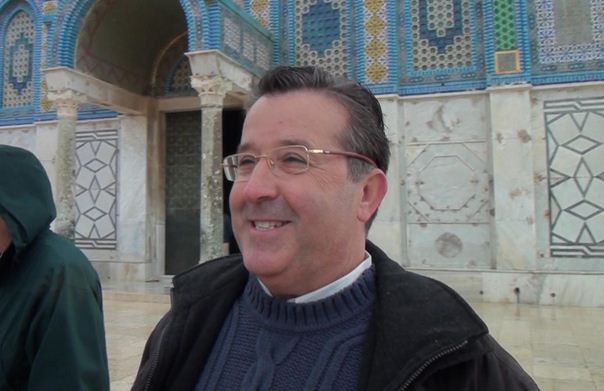
Dr. Ali Qleibo is an anthropologist, author, and artist. A specialist in the social history of Jerusalem and Palestinian peasant culture, he is the author of Before the Mountains Disappear, Jerusalem in the Heart, and Surviving the Wall, an ethnographic chronicle of contemporary Palestinians and their roots in ancient Semitic civilisations. Dr. Qleibo lectures at Al-Quds University. He can be reached at aqleibo@yahoo.com.