
- 21 تشرين الثاني 2013
- أقلام مقدسية
Pilgrimage to the Noble Sanctuary is a transcendent experience. The pilgrim’s first view of the Dome of the Rock is visionary. The beauty of the Noble Sanctuary is astonishing. The architecture evokes the exhilarating feelings of awe, delight, and admiration. Its emotive splendour assuages existential loneliness and stimulates intimations of the infinite. Its immensity, lyricism, and harmony trigger the feeling of the sublime. Tears fall copiously from the eyes of Muslim visitors to Al-Aqsa Mosque. Liberal Muslims, for whom Islam is merely an element of their identity, as well as orthodox Muslims, whose identity is totally defined by Islam, uncontrollably shed tears upon entering Masjed al-Aqsa.
An overpowering sense of sacred presence permeates the precincts and comingles with the architectural beauty of the Noble Sanctuary to endow the encounter with a transcendent quality. Medieval theological colleges, grandiose gateways, water reservoirs, reclusive domed rooms, arches, prayer platforms, domed niches, vaulted galleries scatter asymmetrically in the lower and upper courtyards of the mosque. Above, in the centre of the upper courtyard, shimmers the Golden Dome that enshrines the Holy Rock (al-Qudus), the locus of Prophet Mohammed’s transfiguration in the Night Journey (al-Isra’ wal-Mi’raj). In Masjed al-Aqsa, whence myth and legend meet, divine presence pervades the courtyards and precipitates a paroxysm of tears among pilgrims.
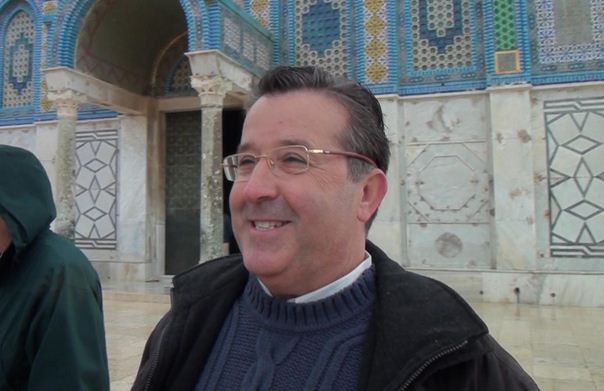
“Subhan Allah” (Glory be to God) comes involuntarily to mind. Standing on the threshold of the Cotton Merchant’s Gate, which provides the most striking aspect of the glittering dome, the faithful are overwhelmed with a vast sense of wonder and delight by the intensity of the moment.
Jerusalem is constitutive of Muslim faith. Prophet Mohammed ordained the faithful to travel on pilgrimage to the three holy cities singled out by name: Jerusalem, Mecca, and Medina. The relationship of the three holy cities, it must be stressed, is not of a hierarchical order but of a dialectic nature based on their value as symbolic expressions of the eruption of the sacred in Islam. “Journeys should not be taken (with the intention of worship) except to three mosques: the Sacred Mosque in Mecca, my mosque in Medina, and Masjid al-Aqsa in Jerusalem.”
The concept of the sacred, القداسة, in Islam is expressed paradigmatically along the lines deployed within a cultural, intellectual, and symbolic context. The complex symbolic paradigms through which the three sacred cities discursively deploy their theologies and traditions include the authoritative symbolism of the Qur’an and Sunnah, Muslim orthodoxy as defined by the Prophet’s actions and sayings, and the consensual interpretations of tradition. Culturally deployed legends and tales add a mystic aspect to the religious event.
During the month of Rajab in the year 620 AD, almost one-and-a-half years before Prophet Mohammed’s Hijra (migration) from Mecca to Medina, the symbolic event of Isra’ and Mi’raj (Night Journey and Ascension) occurred. The Prophet Mohammed made a night journey from Mecca to Jerusalem and thence ascended to the heavens. Whereas the horizontal voyage to Jerusalem is referred to as Al-Isra’, the vertical ascension to heaven is called Al-Mi’raj.
“Glory be to Him Who made His servant to go on a night from the Sacred Mosque to the remote mosque of which We have blessed the precincts, so that We may show to him some of Our signs; surely He is the Hearing, the Seeing.”
- Qur’an, Sura 17 (Al-Isra), ayat 1.
The story of Al-Isra’ and Al-Mi’raj is full of miraculous legends and symbols. The angel Gabriel took the Prophet from Mecca to Jerusalem. There it is believed that the Prophet stood at the Sacred Rock (Al-Sakhrah al-Musharrafah) and then ascended to the heavens whence instructions were revealed about the number of prayers the Muslim community should observe each day. In Jerusalem he met with the biblical prophets and he led them in prayers. After these experiences the Prophet flew back to Mecca astride the mysterious buraq.
Legend portrays a magical animal, bigger than a donkey and smaller than a mule, with lightning speed - hence the name, al-buraq, an anagram of the word barq, Arabic for lightning to denote the element of high speed with which the Prophet travelled between Mecca and Jerusalem. Al-Mi’rajis derived from the word arj (عرج), to drop by for a short visit, and refers to Prophet Mohammed’s rise to the upper skies to seal, in a sense, God’s covenant with the Muslim Prophet. Muslim thinkers, mystics, and poets have interpreted the ascension of the Prophet to the heavens, Al-Mi’raj, in diverse ways to both avoid the reification and anthropomorphisation of God, who cannot occupy one particular space and shun the transfiguration of the Prophet whose humanity Muslims cannot lose sight of. Whether Prophet Mohammed made the journey in body or only in soul is subject to complex controversies. Unlike Christian tradition, in which God became manifest in the human form of Jesus, for Arab Muslims the idea is anathema. The chasm that separates mankind from God cannot be traversed. The Humanity of Man cannot be transmuted to acquire divine attributes through mediating categories, as practiced discursively in Christian theology through the use of concepts such as “apotheosis” or “transfiguration.”
Al-Mi’raj, as a symbolic expression of the sacred, remains shrouded in evocative mystery around which folk culture deployed fantastic narratives. According to folk legend, the Holy Rock, whence the Prophet rose on his “quick visit” to the heavens, as witness to the miraculous eruption of the sacred, has changed and has come to assume a symbolic function as a sign of that mysterious Night Journey. In folk culture it is believed that the rock bears the imprint of the Prophet’s feet. “Stand still,” the prophet stamped his feet firmly on the rock to keep it in its place. It is commonly believed that the rock started to rise along with him to the heavens to meet God, and it would have continued had it not been for his firm command to stay put. The trace of his feet is now enshrined in the south-western reliquary that also contains hairs from his beard. In another narrative, my Sufi friend Al-Sheik al-Jamal explained, “Prophets do not leave traces in the sand, but the stamp of their footprints shows up on rocks.”
That night, according to the Qur’an, God blessed the rock and its environs. Blessed and sanctified by God (الذي باركنا حوله), the rock assumed a new identity as the “Holy Rock” (الصخرة المقدسة). Roman Jerusalem, Aelia Capitolina, assumed its new Muslim identity as the City of the Holy Rock, Bayt al-Maqdis, from which the present-day appellation Al-Quds, the holy, is derived.
There is, however, one essential point to bear in mind: namely, that the Night Journey serves as an expression of every Muslim’s deep devotion and spiritual connection to Prophet Mohammed and to Jerusalem, and as a confirmation of Mecca’s spiritual and symbolic link with Jerusalem.
Throughout the history of Islam a special genre of literature has been deployed to extol the virtues of the three holy cities of Islam: Mecca, Medina, and Jerusalem. Authors of great renown, theologians, pilgrims, travellers, and bards had de rigueur to include in their repertoire a narrative about the magic and wonders that bespeak the holiness of these three cities. The Discourse on the Virtues of Jerusalem (فضائل القدس) is quite distinctive and goes back to the first decades of Islam. Wonderful legends and mythological events find their place in the literature and provide moral and religious education for the plebeians. In one such narrative in relation to the Night Journey we read,
“Then he [Gabriel] brought the Buraq, handsome-faced and bridled, a tall, white beast, bigger than the donkey but smaller than the mule. He could place his hooves at the farthest boundary of his gaze. He had long ears. Whenever he faced a mountain his hind legs would extend, and whenever he went downhill his front legs would extend. He had two wings on his thighs that lent strength to his legs. He bucked when Mohammed came to mount him. The angel Gabriel put his hand on his mane and said: ‘Are you not ashamed, O Buraq? By Allah no one has ridden you in all creation more dear to Allah than he is.’ Hearing this he was so ashamed that he sweated until he became soaked, and he stood still so that the Prophet mounted him.
During the Mi’raj, the Prophet is believed to have received from Allah the command of five daily prayers (salah) that all Muslims must perform. Upon his return to Mecca the Prophet instituted these prayers. It is significant to note that he made Jerusalem the direction (al-Qiblah) to which Muslims must face when they pray. Jerusalem is thus called Ula al-Qiblatain (the First Qiblah). The Prophet and the early community of Islam worshipped towards the direction of Jerusalem during their stay in Mecca. For almost seventeen months after the Hijra (migration), Muslims in Medina also continued to pray facing Jerusalem. Later God commanded the Prophet to change the direction of prayer from Jerusalem to Mecca (2:142-150).
Because of its centrality in Muslim thought, Jerusalem serves as a definitive image and symbol of a sacred place parallel to Mecca and Medina. The basis of its sanctity reflects hierophany - to use a concept favoured by Mircea Eliade - which refers to the eruption of the sacred. The rock beneath the spectacular Dome of the Rock assumed its centrifugal symbolic character as witness to the Night Journey.
Pilgrimage to Jerusalem may be performed within the overall context of the appointed Muslim pilgrimage to Mecca and Medina, al-Hajj, whereby traditionally al-ihlal (الاحلال) - the initiation of the journey - begins in Jerusalem or it may be visited separately. Pilgrims visit Beit al-Maqdis to experience the physical manifestations of their faith, confirm their beliefs in the holy context with collective excitation, and connect personally to Islam through its symbolic sacred expressions specific to the place of hierophany in Laylet al-Isra’ wal-Mi’raj.
“My grandfather came to Palestine on pilgrimage from Morocco early last century,” noted Nadera al-Moghrabi as she explained the history of their extensive property in Jericho despite their Moroccan lineage. “He was overwhelmed by the great spirituality that Al-Aqsa Mosque exuded and decided to settle in Jerusalem.” Al-Moghrabi is a common family name and refers to anyone whose grandparents came to Palestine from Morocco. Similarly, Al-Masri is another common name that refers to anyone who is from Egyptian origin. Likewise Al-Afghani, Al-Bukhari, and Al-Naqshbandi are family names ascribed to Jerusalemites whose ancestors, over the past five hundred years, came on pilgrimage to Jerusalem from Uzbekistan, Bukhara, or Afghanistan and decided to stay. Throughout the centuries Sunni Muslims from diverse ethnic backgrounds and from various Sufi schools of thought, overwhelmed by the holiness of the city, settled in Beit al-Maqdis. Al-Moghrabi continued, “My father lived initially in the Old City, in the Moroccan Quarter, but felt nostalgic for the greenery of his homeland. Jericho was then a peaceful oasis famous for its evergreen bananas, its palms, and its citrus groves. In Jericho he could feel at home yet be close enough to attend the Friday prayers in Al-Aqsa Mosque.”
Nigerian Muslim Africans from the Hausa, Fulani, Bergo, Kalambo, Salamaat, and Berno tribes settled following the pilgrimage to Jerusalem. Both in Mecca and Jerusalem they are generically referred to as Takarnah (singular Takruni) - التكارنه - in contradistinction to the Arabic-speaking Sudanese community. In local lore, Al-Takarnah were considered extremely religious and, as early as the thirteenth century (during the Mamluke period), were traditionally associated with guarding the holy precincts of Al-Aqsa Mosque. Fearsome, pious, sturdy, and known for their honesty, their dignified comportment as guards added a special aura to the mosque. My father remembers the fear they instilled in the children to prevent them from playing football in the expansive courtyards of Al-Aqsa Mosque. They occupy the Mamluke buildings on either side of Al’a Ad-Deen Street leading to Al-Aqsa Mosque. On one side are the Al’a Ad-Deen Busari buildings, completed in 1267 and named after the Mamluke founder of the quarter. On the other side are the Al-Mansouri buildings which were completed in 1282. Both hostels, ribat, are for the exclusive use of the permanent African residents of the Holy City.
Al-Ribat were hostels for pilgrims whose descendants settled in Jerusalem for exclusive worship at Al-Aqsa Mosque. The zawiyeh, on the other hand, provided lodging and spiritual Sufi learning and meditation for the non-Arabic speaking itinerant pilgrims during their sojourn in Bayt al Maqdis. Al-zawaya and the ribat are roughly equivalent to Christian hospices. They proliferated in the Middle Ages throughout the Ottoman period to accommodate Turkish, Central Asian, Indian (before the division of India), and far-eastern Muslims.
From the thirteenth century Moroccan Muslim murabitune settled in their own neighbourhoods. They had participated in the war against the Crusaders and had provided the fleet that joined forces with Saladin in the maritime battles. Relatively well off, they were able to construct huge endowments that consisted of mosques, theological colleges, and houses in a neighbourhood of their own west of Al-Aqsa Mosque, the Moroccan Quarter, which was destroyed immediately following the Israeli occupation of Jerusalem in 1967, to enlarge the Jewish Quarter and to vacate and expand the space that faces the Wailing Wall.
The early Ottoman period witnessed an influx of non Arab pilgrims from the Muslim world: Indians, Afghanis, Central Asians, Indonesians, and Turks who would extend their sojourn in Jerusalem to pray and meditate. Until the turn of the twentieth century and prior to the formation of the modern Arab national states, the inner religious experience, i.e., Sufi meditation, was widely practiced alongside the orthodox rituals of faith. In their respective zawiyeh each community could find spiritual guidance under the sheik who was also the head of the Sufi tariqah dominant in their respective countries of origin. These zawaya (plural of zawiyeh) further enriched Jerusalem’s appeal as a hospitable pilgrimage centre where various Sufi schools thrived. The following zawaya have survived: Al-Zawiyeh al-Hindieh (the Indian hospice), Al-Naqashbandieh, (Central Asians), and Al-Afghanieh (for Afghanis). The Melawiyyeh, once the hospice for the followers of Jalal el-Din el-Rumi, the zawiyeh has become a mosque and its rooms house local families.
Habs al-Abeed, the new unfortunate name for the Ribat al-Mansuri and Ribat Ala’ al-Din, is used to describe the African quarter community that developed consequent to the use of the two ribat as prisons in the late-Ottoman period. After the prisons were relocated in the twentieth century, the Takarneh regained their traditional living quarters in both ribat. However, the old reference to the ribat as prison, habs, lingered. Its Arabic name translates as “The Blacks’ Prison!” To further complicate the matter the word abed in Arabic means both “slave” and “black,” and, as such, the appellation is extremely misrepresentative since Takarneh Africans have always been free. They settled in Palestine voluntarily as an act of faith. Sadly, nothing survives of the Moroccan Quarter, Haret al-Magharbeh, which was totally demolished by the Israelis following the Six-Day War. Its residents were scattered in Jerusalem.
The flexible Ottoman legal administrative system allowed for cultural ethnic diversity conferring legal status on each community through the millet system (ملة), whereby each ethnic group kept its identity sequestered in its own neighbourhood. The liberal Ottoman system played a great role in establishing the ethnic mosaic not only for Muslim pilgrims but for Christians and Jews as well. The cultural heterogeneity of Jerusalem’s population played a great role in creating the cosmopolitan image that encouraged mass Jewish, Greek, and Armenian immigrants to settle in Jerusalem following the disintegration of the Ottoman Empire.
Jerusalem’s patrician families settled as murabitune and accompanied the Caliph Omar in the seventh century AD, knowing fully the symbolic significance of the Holy Rock in Muslim theology. The Nusseibeh family is a prime example. Although proverbially austere and frugal, those who took up residence in Jerusalem throughout the Muslim years did so out of recognition of its holiness. They have forfeited wealth and city comfort for the love of God. Thus the Arabic proverb: The one who settles for little, i.e., the one who can be content with a meagre life, lives in Jerusalem and Hebron, اللي بيرضى بالقليل بيسكن بالقدس والخليل.
Al-Aqsa Mosque’s expansive lower and upper courtyards are dotted with niches, prayer rooms, medieval theological colleges, symbolic gates and arches, water wells, ablution fonts, meditation rooms, and galleries. The architectural narrative traces the fourteen centuries of Islam in Jerusalem. In their totality, the buildings form a virtual archive of a long train of princes, emirs, kings, and religious personalities who immortalised their names by association with the Holy Rock enshrined under the golden dome of the Noble Sanctuary.
Throughout the past millennium Muslims came on pilgrimage to Jerusalem and stayed here in the precincts of Al-Haram al-Sherif. It is believed that the famous theologian Al-Ghazali took up residence in the small theological college on top of the Golden Gate where he started his major opus, Reviving the Sciences of Religion احياء علوم الدين. The sacred in Jerusalem exuded an overwhelming sense of spiritual serenity and transcendence that made it the favourable exile city for deposed Mamluke princes. Their ornate mausoleums were enshrined in theological colleges that flourished in the medieval period.
Inhabited nowadays by migrant workers, the dilapidated and abused yet handsome facades of the medieval Mamluke theological colleges survive as witnesses to the passing of time. They stand as eloquent expressions of Jerusalem’s central position in Islam.
A victim to a turbulent history whose vicissitudes have made it inaccessible to Muslims first during the Crusader Latin Kingdom and now because of the Israeli occupation, the mere name, Al-Quds, triggers an emotional affectual upsurge in every Muslim heart and mind wherein nostalgia, piety, the love of God and his prophet Mohammed meet.
Dr. Ali Qleibo is an anthropologist, author, and artist. A specialist in the social history of Jerusalem and Palestinian peasant culture, he is the author of Before the Mountains Disappear, Jerusalem in the Heart, andSurviving the Wall, an ethnographic chronicle of contemporary Palestinians and their roots in ancient Semitic civilisations. Dr. Qleibo lectures at Al-Quds University