
- 17 شباط 2014
- أقلام مقدسية
“It was the best of times, it was the worst of times, it was the age of wisdom, it was the age of foolishness, it was the epoch of belief, it was the epoch of incredulity, it was the season of Light, it was the season of Darkness, it was the spring of hope, it was the winter of despair...”
Charles Dickens, A Tale of Two Cities.
Jerusalem 1948–1967: La Dolce Vita
By Ali Qleibo
“One last passenger to Beirut.”
The shrill call by the taxi drivers who collected passengers outside Damascus Gate echoes in my memory. Drivers’ voices mix in a cacophony, each advertising his destination:
“Nablus…Amman…Al-Sham (Damascus)…Baghdad.”
“Qalandiya Airport received daily flights from all the capitals of the world.” Muhammad Al-Qutob joyfully remembers these days preceding the fall of Jerusalem during the Six-Day War in the summer of 1967. “Kings, heads of states, dignitaries, and great actors and singers visited Jerusalem through Qalandiya.”
“Jerusalem was truly cosmopolitan. There were stylish boutiques and elegant hotels, cafés, and restaurants. The Old City teemed with sophisticated, educated, worldly Jerusalemites who had moved with their parents and grandparents following the fall of the western suburbs in 1948 pending their return home.” Ibtisam fondly recalls her adolescent years.
“They were not rich but they had manners and style.” Mrs. Judeh, a school teacher, is critical. “It was shortly after Palestine had gone; they had lost their jobs and their homes, and the majority were very poor.”
Most concur that the Jerusalem of the fifties and sixties had character; its dynamism was vitalised with highly individualised individuals who were refined, cultured, and high-strung, yet diffident. Jerusalemites defined their identity in modernist Western terms that redefined and defied conventional social norms. When their indulgencies became excessive, Kuwait, Cairo, Beirut, Paris, or New York provided an outlet. After the fall of Palestine, social values lost their hold for many, and those who could afford to explore their existential needs simply moved on. It was time out and there was no holding back, they had no patience for social games and hypocrisy. This is the period of existentialism, and the Lebanese feminist author Layla Ba’albaki was the rage. Her first novel, I Live, was an instant success. To question social values and norms and to quest for “meaning” became fashionable. Her second novel, Rocket of Tenderness to the Moon, which was replete with sexual overtones, culminated in her imprisonment with street prostitutes in Beirut. She was accused of sexual sedition and pornography. At her trial major Arab authors rallied in support to discuss freedom of expression in literature, adding further legitimacy to the rising sense of individualism of the era. It was a different time, a different culture, and a different mind-set that was nurtured under the British or French mandate system. It was a time when Jerusalem was closely connected to cosmopolitan Beirut and Cairo and before our isolation under occupation. Decades later when, as an adult, I met a few of these ladies – already in their late seventies – their cultured eloquence, independence, and sense of “freedom” humbled and shamed me by revealing my own provincial conservatism in contrast.
Staid yet colourful people stayed on and were the bright landmarks in the grey city of stones. I remember Madame Shick and her terrier. She lodged with her husband at the Lawrence Hotel and ran the elegant women’s boutique on Salaheddin Street adjacent to Atlas store, which catered to young adolescent girls and boys and their taste for stylish clothing. Sarkis, Jerusalem’s glamorous beautician-cum-hairdresser coiffed the ladies of the city in his salon, Rome-Paris; lovers and friends had their trysts in the classy Patisserie Suisse. People used to read. The Taha Bookshop specialised in English-language books, novels, and magazines, and Al-Muhtasib imported Arabic books and novels from Egypt and Lebanon. There was the Ummaya Restaurant and the elegant terrace of the National Palace Hotel. The American Colony was run discreetly, and the clients then were local. As a boy of seven I was initiated into the world of adolescent girls as the necessary chaperon as I accompanied my teenage aunts on their forays into the Old City, when Damiani, on Christian Quarter Street, had the latest music records of the period: the early Supremes, Elvis, the hits of the San Remo-style songs. It was the very beginnings of the Beatles, but Lesley Gore songs played everywhere, “It’s My Party and I’ll Cry If I Want to,” competing with Salvatore Adamo’s “Tombe la Neige.”
“Where do these people come from?” exclaimed an 85-year-old friend, Samia, on her annual visit to Ramallah from Paris. “They did not exist before. We never saw them then…”She is surprised by the veils, by the conservative religious garments, and by the overall Arabisation of both Jerusalem and Ramallah.
“The late fifties and sixties were the good old days.” Ibtisam yearns for the sweet life on the eve of the final loss of Jerusalem. “It was ‘la dolce vita,’ she insists. There were many parties; women went freely here and there, to dance parties, to visit, to restaurants, or simply to enjoy a mishwar, a promenade, or window-shopping along Salaheddin or Christian Quarter Street.” She smiled nostalgically, “It was common to see women out and about in open dresses, cut sleeves, short skirts…”
The Old City streets swarmed with well-dressed people with special stress on elegance that was epitomised and caricatured by the popular character of ‘Aruset al-Suq, literally “the market-doll lady.” For every place and time, among Jerusalemites, there was a dress code. You dress up for certain occasions, the Sunday dance at The Grand Hotel in Ramallah or the home-held soirées. There were clothes for the afternoon receptions. Every woman held a reception, istiqbal, on an appointed day of the week, on a biweekly or monthly basis, when her home would be open to receive female friends and relatives in the salon. This was a special event on the social calendar for which they dressed accordingly. Then there were the clothes designed for casual visits to friends or simply to go out window-shopping. It was the period before the “prêt à porter” dresses became popular and when couturiers helped by tailors still proliferated, translating moda from international magazines (such as Burda) into elegant dresses and skirts for all occasions. In violation of these laws, Arouset al-Suq dressed to the hilt at all times and, as such, stood out as a proverbial oddity. “Like Arouset al-Suq” became an epithet to describe women who overdressed and had poor judgment in selecting proper attire for the diverse occasions of Jerusalem’s social life.
“It was very cosmopolitan then. People looked and acted different. It is as though Martians have moved into Jerusalem and replaced them.” Samia could not connect to the present-day Ramallah or Jerusalem public scene.
“It was also a time of political unrest. My only memories are of the demonstrations following the Israeli raids of Al-Samu’.” Mrs. Judeh did not remember the style, songs, dances, or dresses. Every individual and each generation has its own distinct memories; an age difference of two or three years can make a great difference. Gender further delineates the boundaries of subjective experience. As a young boy I was taken to the dance parties of the early sixties but I could relate more to Mrs. Judeh’s memories of the mid-sixties. “The Jordanian camel battalion, al-hajjana, filled the streets of Jerusalem to stop the riots in the years 1964 to 1966.”
In view of the escalating nightly Israeli/Jordanian skirmishes that had already moved from the southern Hebron front line to Jerusalem, demonstrations became commonplace. Palestinian pro-Arabists and pro-Nasserists had gone to the streets asking for armaments to be able to defend themselves against the threat of another Israeli takeover. There were grievances against the Jordanian regime’s economic policy that sought to develop the economic infrastructure east of the Jordan River and blocked major economic projects in the West Bank. No steps were allowed to be taken towards building an infrastructure that would lead to an independent Palestinian state. Palestinians, like all the Arabs of the period, lived the euphoria of pan-Arabism. Meanwhile Jerusalem and the West Bank, according to the Jericho Meeting in 1950, were quietly annexed to Jordan. With the demise of the Husseinis and Nashashibis following the Nakba, the remaining Palestinian leaders were co-opted by the Jordanian administration, where they became civil servants.
“The mid sixties was the period of the fida’i, the freedom fighters. Fateh, under Yasser Arafat, was established in Egypt by Jamal Abdel Nasser to become the legitimate representative of the Palestinians.” Mrs. Judeh explained the consequent turbulences of 1964 to 1967. “Dissatisfied with the annexation of the West Bank and the prolonged waiting for the return to Palestine, the people took to the streets. There was a regular daily exchange of fire in Jerusalem, and the Palestinians lived in fear that the Israelis would move in and slaughter them. The Deir Yassin massacre was still fresh in their memory.”
Recollections are fragile mementos of the past; rolling pearls whose thread has just snapped. Random, obdurate, and elusive scattered historic events disperse and coalesce in clusters to project meaningful patterns. Neutral happenings, cold like pearls, assume with hindsight special significance. Selected events glisten warmly in the recesses of memory. Time imparts the past with a magical halo.Some individuals and certain events leave an indelible imprint while many others fade into silent oblivion. The rich details of the lived moment are reduced to cold disjunctive building blocks of narratives deployed to construct a coherent sense of identity.
I was born seven years after the Nakba into a ravished city slowly being depopulated. Thousands of professional Jerusalemites found themselves suddenly homeless and jobless, crammed within the walls of the Old City, living with their parents and grandparents. I remember the Old City bustling with people, but it was fraught with sadness. Almost everyone seemed to be waiting for an immigration visa to America or for a job in the Arabian Gulf.
Jerusalem by the early sixties had developed the character now deeply impressed in me; a city of old people clinging to memories about a period of time in the past, when families lived together: a paradise lost.
Jerusalem was a sad city. Nostalgia, since normal life had long ceased to exist, permeated every step that Jerusalemites took. The spectre of solitude hovered over each home; not a single family was spared the wounds of separation.
People’s major preoccupation was waiting; waiting for the return of peace, for the return of loved ones, and for the family reunions during the summer vacations, during the holidays.
“Mohammed loved these artichokes.” My grandmother’s tears would drop into her plate as she remembered her children. Of 13 aunts and uncles, only two, apart from my mother, remained in Jerusalem. The house that was bustling with the vitality of my high-strung, rambunctious uncles of various ages was now empty, except for my grandparents and my widowed aunt Wijdan.
Jerusalem, as I think back to my childhood, was sad. I was mostly surrounded by old people and their memories.
Ennui plagued us. Our only respite, for the very few who could afford the indulgence, was the prospect of breakfast in Damascus followed by dinner that same evening in cosmopolitan Beirut. Qalandiya Airport provided a few flights a week to Cairo where the great divas of Arabic music gave their monthly recitals. A visit to Cairo was our access to the backdrop of all the films and love stories that we knew through the three cinemas of Jerusalem: Cinema Al-Quds, Al-Hamra, and Al-Nuzha.
To fly to Cairo was to visit the land of dreams, of romance, and of magic. This was the heyday of Cairo before nationalisation of private capital. We would return from Beirut or Cairo a week later to the loneliness of Jerusalem.
Love, for the Arab generation of the period, was invented in Cairo. The film, Al-Wisadah al-Khalieh (The Empty Pillow), is considered one of the ten best films in Egyptian cinema. It glamorised love and, combined with the songs by Abdel Halim Hafez, legitimised loving, living for love, and dying for love. For without great love, al-hob al-kabeer, life had no meaning. My daughter Aida describes the de-formative influence of the cinematic musical concept of love: “In their view the only true love is the love in which one is hurt. That trauma in love must be followed by a great artistic expression. If this artistic achievement does not ensue then the love is not true. People must suffer but most importantly create great art in order to be really in love.”
Following the great excitement over The Sound of Music, Jerusalem was swept off its feet by the compulsive, obsessive love story of Lara and Yuri in the classic film Dr. Zhivago. We would leave the cinema to the bleak reality of a city under siege reduced to one-fifth of its original size and cut by a barbed-wire fence. This was the great era of Um Kulthum and Mohammad Abdel Wahab that culminated with the classic song, “Inta Umra,” whose opening verses summarise the central importance of love: “My life began the day I met you ... all my years before were a waste.”
Nostalgia, melancholy, and an unfathomable sense of solitude; Jerusalem came to embody these feelings.
The depopulation of Jerusalem was brought about by the depressed economic conditions, the result of the Arab/Israeli political conflicts of the thirties, and the ultimate rejection of al-taqsim of 1947, the term used then to refer to the two-state solution. The violence escalated into endless battles culminating in our loss of Palestine in 1948.
The Arab world encouraged and propagated the “myth of return” with which the Palestinians became obsessed; sooner or later, the conflict would be over ... the return was imminent. Throughout the fifties and sixties East Jerusalem lived in the dream of the return.
I grew up in the shadow of a grim wall topped by barbed-wire fences that cut through Jerusalem separating the Israeli side from the Arab side. Unlike the preceding generation I had become accustomed to the greater part of the Musrara and the Jaffa Gate quarter,“no man’s land,” ravaged by the bombing that took place before my birth.
Decades later winter still triggers and pokes images and scars of the melancholic Jerusalem of the sixties. I see myself walking up the steep winding alleys from Damascus Gate towards New Gate to the Freres’ school. Late in the afternoon, I would trudge the same way back home with wet shoes, soggy socks, and cold feet ... I shudder at the memory of those days. Days of rain, hail, and sleet followed endlessly.
Jerusalem exudes a sense of forlorn deep-grey melancholy. Winter intensifies the grey into hues of deep lead. From November to March the stones turn grey. The sky turns grey. The purple shadows in the cavernous anater (covered passageways) turn black-grey. The blue mosaics of the Dome of the Rock turn grey; its golden dome hardly glistens.
Deep in my memory infinite hues of melancholic grey and inexorable cold fuse with the pain of the barbed-wire fence that extended from Damascus Gate all the way up northward to Jenin.
Jerusalem of the sixties was a ravished city; a forlorn mountain fortress of monasteries, churches, and mosques where faith and poverty dovetailed into a single braid of huzon: nostalgic melancholy.
The trauma of the Nakba was still an open wound. The Jerusalemites, now refugees in the Old City, were waiting for their visas that would allow them to emigrate to anywhere in search of work and a temporary home. The end of the sixties saw the last of cosmopolitan Jerusalem; it was a dying city.
In the lost time, cinema, music, Sunday dances, visits to Beirut or Cairo provided temporary distractions from the trauma of the Nakba. It was time out. The “outings” offered a temporary break from the grey life in the shadow of the barbed-wire fences. Living in denial, they indulged in the little pleasures of life. The huzon of Jerusalem was bleak. We were biding our time.
In the aftermath of the Israeli occupation, the last middle-class cultured, sophisticated, and worldly Jerusalemites emigrated or simply passed away of broken hearts or old age…. A few Jerusalemites linger; dinosaurs who recall the fifties and sixties as the good old days of the Sunday dance at The Grand Hotel, the elegant restaurant hotel in the woods of Al-Qubeibeh next to Emmaus, the outdoor restaurants in Beit Jala, and the Castle of the Pools in Artas.
Nostalgia to the sweet bird of youth selectively reconstructs a dolce vita. It was a dance macabre, a death dance marking the loss of Palestine. The time of grief is forever deferred. We survive moment by moment. The heart of Jerusalem still beats.
Dante Alighieri aptly summarises our nostalgic melancholy.
“We are lost, afflicted only this one way: that having no hope, we live in longing.” The Inferno, Canto IV.
My vision of Jerusalem is intensely personal. Nostalgia, longing, and an unfathomable sense of loneliness envelop Jerusalem in a halo of huzon; a bittersweet refrain whose echo reverberates behind every step in Jerusalem. The feelings overflow into art. The sensation coalesces into words that dissolve into pigments of light and shadow. The image solidifies into lines, volumes, and colour. The feelings become a painting.
Reality is that of the heart.
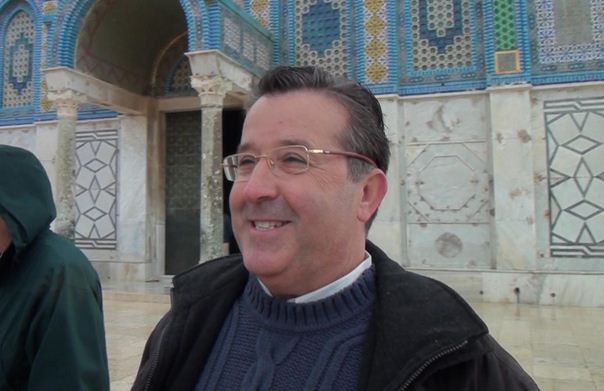
Dr. Ali Qleibo is an anthropologist, author, and artist. A specialist in the social history of Jerusalem and Palestinian peasant culture, he is the author of Before the Mountains Disappear, Jerusalem in the Heart, and Surviving the Wall, an ethnographic chronicle of contemporary Palestinians and their roots in ancient Semitic civilisations. Dr. Qleibo lectures at Al-Quds University. He can be reached at aqleibo@yahoo.com.